Leaving Your Fish Tank for 2 Weeks? Rehearse It First
August 25, 2026
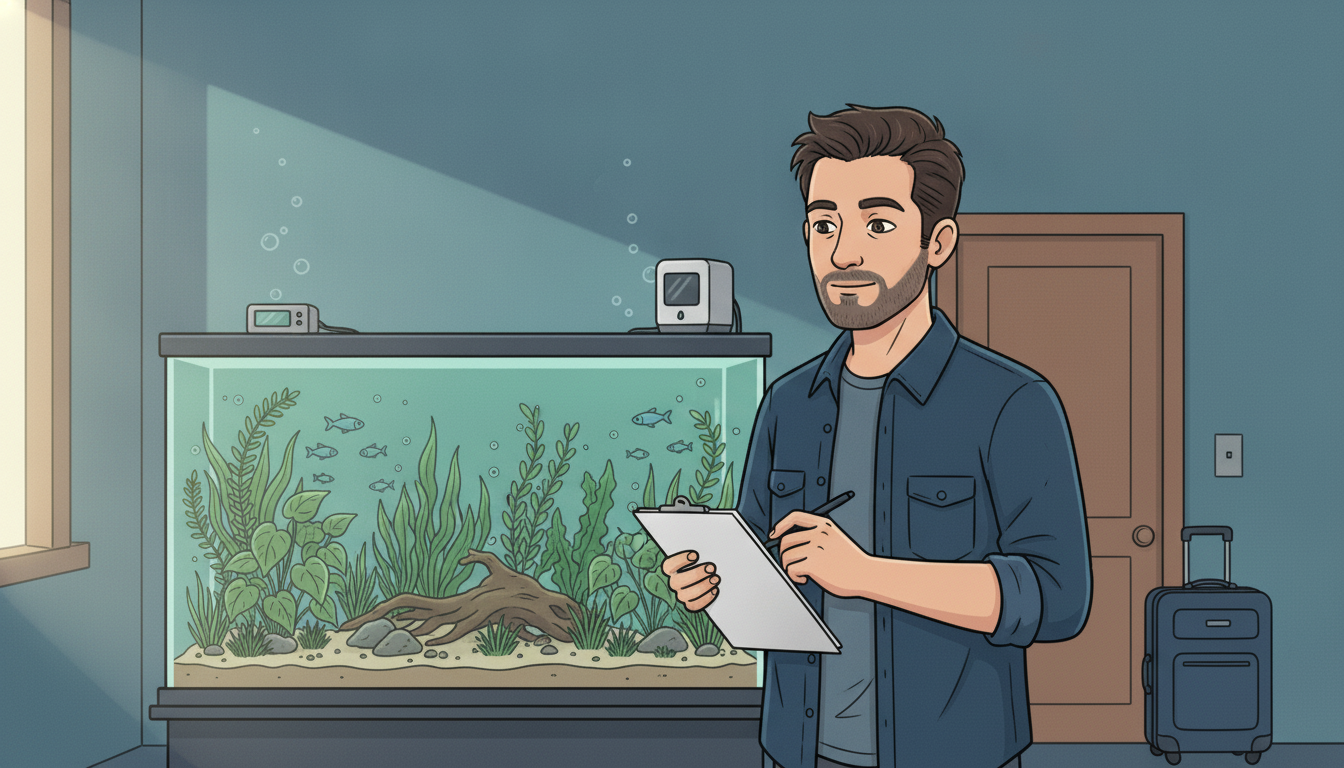
Most people prep for a trip by setting the auto-feeder the morning they leave, saying a little prayer, and driving to the airport. Then they spend two weeks half-wondering if the tank is fine.
I do the opposite. Before a two-week trip, I run a full week where I pretend I’ve already left. Same feeder, same timers, same everything — except I’m sitting ten feet away, watching for the thing that goes wrong. Because something always tries to.
I call it the mock vacation, and it’s the single best habit I’ve ever picked up as a fishkeeper. A fail-safe you’ve never tested isn’t a fail-safe. It’s a guess. The whole point of the dress rehearsal is to turn every guess into a “yep, watched it work.”
Here’s the run-through I use.
Start early, not the day you leave. Do your last water change three to four days before the trip, not the morning of. A water change is a small shock to the system, and you want the tank to settle back to normal while you’re still there to watch it. Changing water an hour before a cab shows up is how you leave on a bad note you can’t see yet.
Feed the tank the way the machine will. Load the auto-feeder and let it do every meal for a full seven days. Don’t hand-feed on top of it. This is the big one, because auto-feeders have two classic failure modes: they clump up in humid air and skip a meal, or they dump way too much at once. You want to catch either while you can still fix it. A quick fix that helps a lot: toss a small food-safe desiccant packet in the hopper to keep the food dry and flowing.
Feed less than you think. Fish are fine — genuinely fine — eating light for two weeks. A little hunger hurts nothing. Rotting extra food hurts everything, because it fouls the water and spikes the stuff that’s toxic to fish. When in doubt, set the feeder smaller. An underfed tank comes home healthy. An overfed one comes home cloudy.
Put the lights on a timer and leave them shorter. Long, bright lighting with nobody there to manage it is an open invitation for algae. I run a shorter photoperiod when I travel and let a timer handle it exactly the same every day. Plants keep growing, algae stays starved. Set it, then watch the timer actually flip on and off on schedule for a few days.
Fight evaporation before it starts. This one bites people in dry climates especially — and Winnipeg winters are bone dry. Over two weeks, an open-top tank can lose enough water that the filter starts sucking air and burns out, or the heater ends up exposed. A well-fitted glass lid cuts evaporation down to almost nothing. During your mock week, mark the water line with a piece of tape and see how far it actually drops. That number tells you if you’ve got a problem.
Never make a big change right before you go. No new fish. No new plants. No rearranging, no new equipment, no “quick” upgrades the week before a trip. New anything means a new variable, and a new variable is exactly the thing that breaks while you’re gone. Boring and stable wins. Save the fun projects for a week you’re home.
Write down what you touched — then don’t touch it. By the end of the mock week you’ll have a short list: feeder portion, light hours, water line, anything you tuned. That list is your travel setup. The rule from there is simple. Once the rehearsal passes clean, stop fiddling. Confidence comes from the week you already watched it run, not from one more adjustment on the way out the door.
That’s the entire method. It’s not clever and it’s not expensive. It just moves the moment of failure from “somewhere over the ocean, out of your control” to “Tuesday afternoon, while you’re right there to fix it.”
The first time I did this, I caught a feeder that was skipping every third meal because the humidity in the room was gumming up the wheel. Ten-dollar fix, five minutes, done. If I’d found that out from 3,000 kilometres away, there’d have been nothing to do but worry. Instead I flew out knowing — not hoping — that the tank would be fine.
Two weeks later I walked back in the door, and it was.